The Realm of Reason

"In the vortex of this debate, once the battle lines were sharply drawn, moderate ground everywhere became hostage to the passions of the two sides. Reason itself had become suspect; mutual tolerance was seen as treachery. Vitriol overcame accommodation." - Jay Winik, April 1865

Sunday, February 28, 2010

Day 12 In Okinawa


I don't know if Japanese milk has changed, or if I somehow got used to it after not having had it in 14 years, but it is pretty acceptable.  It used to taste like it as produced in America (or some other far off place), set on a shelf until it expired, then put on a slow boat for Japan, finally arriving in the  refrigerated section of the local Sane for consumption by the poor locals who didn't know that milk isn't supposed to taste that bad.  At least, that was my theory as I was trying to reconcile my love for breakfast cereal and my disdain for Japanese milk.  (The milk lost, and the cereal got the bench for 2 years.)  But now, it's not so bad.  I'm not sure what happened to it, but no matter, I like it now.So, talking in Japanese church is a challenge when you really haven't spoken much Japanese since the beginning of President Clinton's second term.  But, going into it, I was feeling pretty good about things because I had spent almost two weeks in Okinawa speaking Japanese with Miwa's parents, Obaas on gateball fields, and teenagers working at Family Marts.  I figured I would be fairly well prepared for the task at hand if I just took the time to think through my topic (one which was not assigned to me; I had to come up with it), consider how I would say it, and go forth with faith.

But a funny thing happened on the way to the "Amen" of the talk  First, Miwa spoke before me on a principle that, while completely in concert with my topic, can seem a little contradictory at first glance without a lengthy explanation involving more linguistic capability than I had at my disposal.  I realized this as she was wrapping up her comments, and I began to flip through my scriptures for another topic for me to speak on.  I quickly came up with something, and concluded it in my mind just as she said "amen."

Now, normally, this is no problem.  I can get up with a few bullet points and shoot from the hip.  I've done it many times in front of audiences large and small, far and wide.  But in preparing my initial game plan, I had actually thought through how I was going to say what I wanted to say.  The grammar and the vocabulary.  Now, I had very little of that preparation available to me.  But, I got up and gave it a shot.

As I said "amen", I realized another important thing about speaking to an audience versus having a conversation with someone.  that is, in conversations, one rarely actually constructs complete sentences.  I've spent the last two weeks conversing with folks, cleverly hiding my poor Japanese skills by reserving my utterances for thoughts that can (and often were) finished by the other conversationalist.  But, giving a speak, shooting from the hip - that's another story. 

The one thing I did do that had one redeeming quality, I thought, was bore my testimony of what I knew.  There is a very basic grammar structure involved with doing this that has been burned into the minds of every missionary serving in Japan.  So when I sat down, I thought to myself, "at least they understood that."

The compliments after the meeting flowed like milk and honey in the land of milk and honey.  I had a hard time figuring out if they were just being Japanese (meaning, "polite") of if there was a bit of divine intervention.  My wife assured me that I did a good job, and that she wasn't being Japanese about it.

Which reminds me of something I have often noted throughout my life.  That is, despite my being a doofus, divine intervention is the cause and reason for most successes in my life, be it landing a hot wife, or giving a discernible talk in a Japanese church.

Waiting for the tsunami.
Shortly after the intervention, Miwa and I hit the road for Yagaji Island and Kouri Island up near Nakijin.  The weather was spectacular today, and the sparkling turquoise waters hovering over the coral reef promised to be...spectacular.  On our way up, we heard of the tsunami sent hurling our way from the 8.8 in Chile, and as we arrived at Yagaji Island, the cops were there to greet us and tell us not to go on the beaches because we'd all die.  Not really, but the prediction was a 3 meter tsunami wave, and that we had about an hour before it hit.

So, taking heed of the counsel, then quickly blowing it off, we went to a beach without cops, waded in the water, joined some other morons enjoying the great weather, water, and view for a few minutes before we left for higher ground (the Kosoku doro) as a means to get back to Nishihara.  It turns out that the wave was only 10 centimeters high, and arrived a couple hours later than the predicted time.

Saturday, February 27, 2010

Day 11 In Okinawa

So, working with the Boy Scouts, I tend to be a little more aware of my surroundings and potential hazards that most (y'know, "Be Prepared").  But, really, who does tsunamis and earthquakes better than the Japanese?  I had never experienced either during my two years in Okinawa.  In fact, the only shaker I've ever felt was a 5.4 in the Portland area during my senior year of high school.  Yes, in Okinawa, we (missionaries) got slammed by typhoons every other day during typhoon season, and those were quite fun.  (I vividly recall hurrying out of our typhoon-confinement in our apartment to hit the McDonalds while the eye of the storm moved slowly overhead.  The baffled expressions on the faces of the employees were reward enough for the risk associated with hustling back to the apartment before the eye passed and the back end of the storm hit.)

But this morning, we were awakened by a 7.0 quake.  It didn't feel that big because it wasn't that big by the time it traveled the 22 vertical kilometers and 81 horizontal kilometers (it struck east of Nishihara).  As if the rolling wasn't enough to awake us from our stupor (or, slumber), we were then notified by the local village loud speaker that "a tsunami is coming, but don't worry about you're on the other side of the island."  Even for those who were on the tsunami side of the island, they had little to worry about as the tsunami was only large enough to get a few surfers excited.  

The second shock of the morning greeted me as we sat down for breakfast and I found some goya in my egg thing.  For those of you fortunate souls who have never eaten goya, it tastes like freshly mowed lawn.  Really bitter and really...green tasting.  Apparently, it is one of the secrets to the long living Okinawans.  Their average age is about 187 years old, but if you have to eat goya to get there, pass me the meat and gravy, and let me die at 72.  (Seriously, though, it was not uncommon for me to chat it up with an 100 year-old obaa working in the sugar can fields.)  The rest of the breakfast foods served to us were nothing like the cereal and milk I am used to.  Yeah, there was an egg something-or-other with goya in it, but other than that and the reddish rice, I don't think I could identify exactly what I ate.  Most of it was pretty good, though.

After breakfast, we went up to Hedo Misaki, one location I never had the opportunity to go to while serving on a bike.  I tried to convince one of my companions in Gushikawa that we could make it up there and back on a P-Day, but he demurred.  Having driven it now, I'm convinced we would have been hard pressed to pull it off without having to stay the night in the Ishikawa (or even Nago) apartment on our way back.  Besides which, we never would have gotten permission to leave our zone for that purpose.  Traveling down the east coast of northern Okinawa is a bit like driving in the inaka portions of the Oregon coast.  Very rugged, very beautiful, and very lonely.

Every once in a while you would run across a small pocket of population which made you wonder where they went for groceries...until you realized that they do it the old fashioned way - they catch it or grow it themselves.  Every so often (and this, mostly on the west coast on the way up), we'd spot a huge parking lot obviously designed for tour buses with a big and busy looking store there.  I'd ask what it was, and the answer was that it was a souvenir store.  "A what?  Why here?"  A foreign concept to me, but somehow it made sense.  Perhaps it was a glorified rest stop where wearied Japanese tourists would need to stop to use the washroom...and buy a few o-miyage's.  

Either way, we didn't stop at those spots.  Our touristy spots were carefully chosen and mapped out, and it was a great day...despite the early morning wake up call and the goya.
The Gushikawa Apartment

Day 10 In Okinawa

So, my brain was fried.  Japanese for 10 straight days without maintaining it is a bit like a life-long cigarette smoker quitting cold turkey; after a while, the head starts pounding,  your arms feel like they're 15 feet long, and you begin to sincerely wonder if lung cancer is all that bad.  (Not that I've ever smoked in my life.  I'm just paraphrasing the reaction the character "Dave" had on the tv show "News Radio" after quitting coffee for 10 hours.)  I began to think perhaps that my Japanese language skills during my mission were less than the gift of tongues, and more in the neighborhood of "gift of sufficiency."  Maybe I wasn't as good as I remember.

But then, a ray of light, direct from Kobe.  Some guy sitting across from me, Miwa, and the in-laws in a little hut next to a small motel somewhere near Okuma (north of Nago) was a real talker, and I somehow understood everything he said.  Everything.  There were about 4 or 5 words he said that I didn't know, but I understood what he said, asked Miwa each time, and got the translation.

We were at a motel north of Nago, sitting in a high ceiling'd hut with a fire pit in the middle, and a brick counter top going around it.  The fire pit was there to keep us warm, the food that was served to us by the motel owner could not have been more Okinawan.  We really weren't able to figure out what kind of fish we were dissecting and eating, but we were pretty sure they caught them earlier in the day.  The only "normal" looking food served to us was sashimi, of some fish variety we spotted earlier at the Churaumi Aquarium (we'll return to this).  We each got about 7 or 8 dishes with different foods in them, none of which I know the name of (I didn't bring my notepad).  But, again, none of them could be considered as recognizable as "normal" except for the sashimi.  All very exotic, and as I followed the conversation between the mother-in-law and the Kobe guy, all very Okinawan.  Most of it was quite good.

This was a long day on the road.  We did some touristy things, I confess, but worthwhile, I think.  Since we were with the folks on this 2-day swing up to the North side, we didn't do my normal "hey, let's see where that road goes!" routine.

First stop was Manzamo, which is one of this enlaces that you will see a picture of if you Google image Okinawa.  We took pictures, and I then pet a cat (one of the few that didn't look diseased).  Next stop, Churaumi Aquarium.  This place is actually a touristy spot worth hitting, and new since my mission.  Apparently it's the second largest aquarium in the world, and it is very cool - especially when you're the tall gaijin who can look over the heads of the Japanese tourists to see displays.  More pictures were taken.  After the touristy spots, we really wanted to hit the three islands that hang off the Motobu Peninsula (Nago area), but the weather was lousy.  These islands are surrounded by spectacular reefs and turquoise waters, but most of the beauty is lost when the rain is coming down sideways, and the dark clouds above look like something out of the Book of Revelations.  We went to the motel, had an unreal amour of Okinawan ryouri, and re-established a small amount of self-confidence in my Japanese.

Thursday, February 25, 2010

Day 9 In Okinawa

Gateball: a lot like croquet, but played by Obaas and Ojiis (old women and old men).  I've been looking out for a game in play.  But really, finding one whilst tooling around the island is long odds.  Today, however, I found one.  Rather, my wife spotted it while we were in Gushikami.  We were down south on a mission to pick up some Okinawa glass we had ordered to have our last name carved into.  Wicked cool looking.  


While meandering back from the glass factory, we spent some time on a beach just south of Itoman.  When the tide is out, you can walk out to a couple islands attached to the beach.  Pretty cool, too.  Hodson, Loris, Johnny and I went there once, and had to hustle back to the shore as the tide was racing back in, and nearly stranded us on the islands.  Miwa and I had no such problems.  We sauntered our way out, talked to some lady who was heading into the waters to gather some sort of seaweed.  We took some pictures, then got back into the car to continue our meanderings.

Like I said, as we were passing through Gushikami, Miwa spotted about 8 Obaas and 1 Ojii playing Gateball.  I had to watch.  We swerved to make a turn into a neighborhood, parked on the narrow street adjacent to the flat grass and sand field, and parked our bums on a bench.  They didn't notice me at first (the big gaijin sitting behind one of them).  There was one in front of me with her back to me, all  the others were on the other side of the field.  When the Obaa in front of me made a good shot, my quiet, but discernible reaction startled her.  She turned around to see a gaijin grinning at her.  I encouraged her, and she followed her ball back toward the others who were playing, giggling as she went.

It was quite a spectacle, watching all of these Obaas heckling, coaching, and kibitzing each other's play.  I never really learned the rules of the game, but as Miwa and I sat and watched, we think we picked up on most of them.  As the game wrapped up, they all went and sat down on the other bench on the field.  We moseyed over and asked them if I could take a picture with them.  They giggled, offered us snacks, and I sat down and broke snacks (not bread) with them.  Miwa snapped a few shots, told them our story (that we are from the States, but Miwa is a local, and I had spent a couple years here).  They asked where I lived, and I told them Shuri, Itoman, Naha, Gushikawa, and Tomigusuku.  Of course, they were quite pleased to hear that I lived in Itoman for some time, the closest location to Gushikami.

As we sat there chatting (me calling them a group of bijins, and they continuing their giggling and food pushing), I saw some tour buses go by, departing from the nearby Heiwa Koen (Peace Park).  If you've ever seen those buses, you know folks get right off the plane at the airport, hop on the bus, go to the hotel, get back on the bus, and from one tourist trap to another.  The tourist spots, I suppose, have their value.  But I couldn't help to think that the folks on the buses would have been much better served if they had parked the bus next to the Gateball field, gotten out, and watched these Obaas for a few minutes, listen to them banter, and eat some snacks with them.

Okinawa isn't Kokusai Dori, Heiwa Koen, or the Monorail.  Okinawa isn't even Shurijo.  Okinawa is Obaas and Ojiis playing Gateball.


Day 8 In Okinawa

Japan's version of McDonalds, in my opinion, is Hokka Hokka. Well, I should say "was" Hokka Hokka. I had longed for a visit to that fine dining establishment, yearning for its simple katsu curry.  Really, it's nothing special.  Like I said in another post, it's as common as oatmeal in the States.  Or, perhaps, to stay consistent with our earlier comparison, as common as a burger.  But, alas, Hokka Hokka's successor is Hotto Motto.  No matter to me, the name change, the katsu curry is still remarkably sufficient.

I was really disappointed with only one thing about my visit to Hotto Motto.  They don't sell t-shirts like In & Out does. 

We hit Hotto Motto on the way up to Gushikawa.  As you may recall, we tried going there the other day, but got lost (because we were going to it from an unfamiliar direction), and besides, the weather was lousy, with a good amount of rain falling.  The biggest feature to going to the Gushikawa area was to head out to the islands that are attached to the Katsuren Peninsula by a long and very skinny bridge.

For those of you who wandered out onto Henza Island around the time of the Okinawa dendobu, you'll recall that they were building another bridge connecting Henza Island to Hamahiga Island.  As the consummate explorer, I was distressed that the bridge remained incomplete during my tenure in Gushikawa.  However, the bridge is now finished, and Hamahiga Island is well worth the visit.

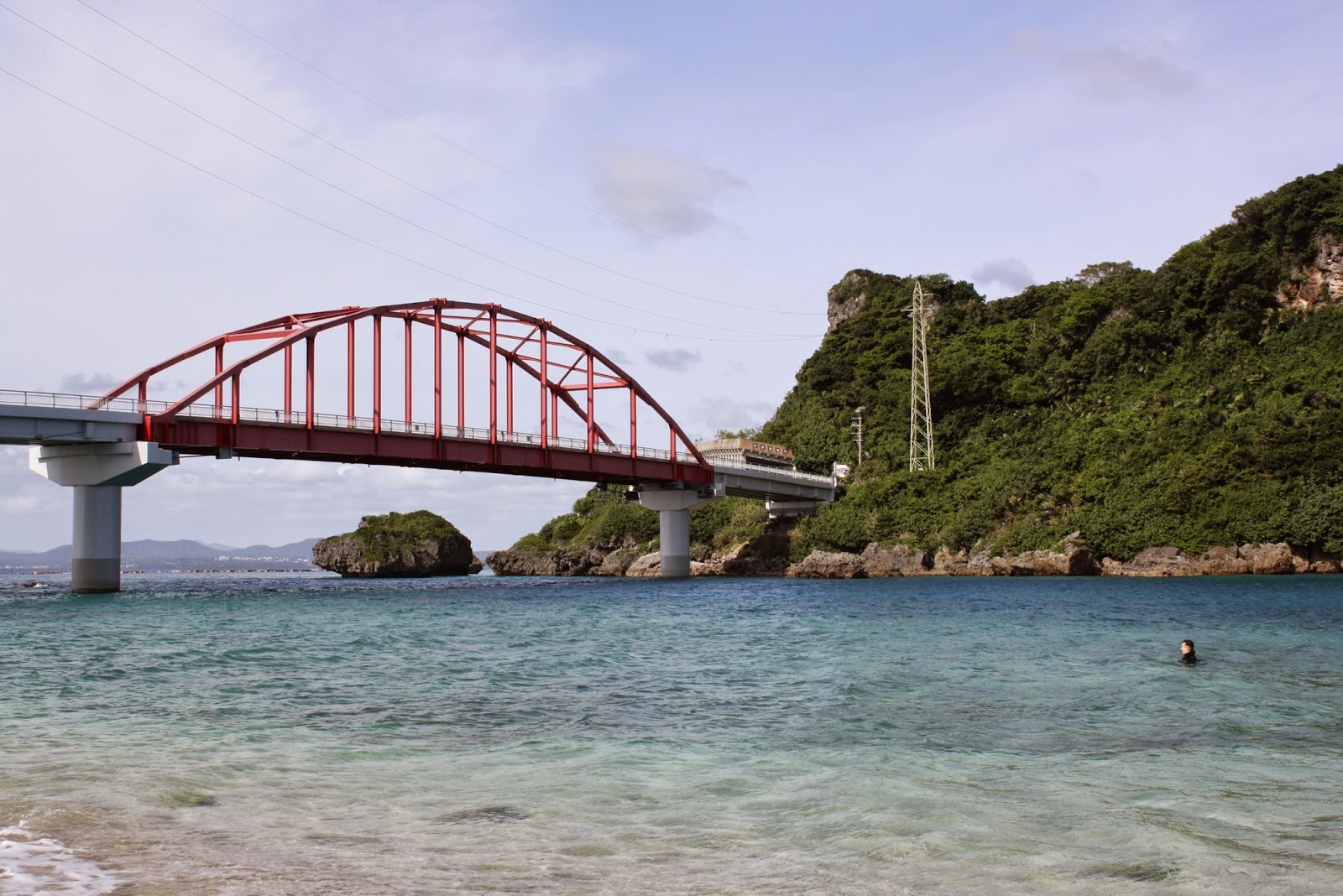
Between Ike Jima and Miyagi Jima there is a red bridge that connects the two islands.  The water is ridiculously gorgeous.  I took pictures of the bridge and the water when I rode out there on a day off with my other missionary compadres, and have always wanted to go back to test out the waters.  I've had dreams about diving into these waters.

And so I did.  We had to park on one side of the bridge and shimmy down a little trail, but we managed to get to a small private beach.  It was righteous.  The water was as chilly as it was yesterday, but with my lady watching from the beach, I couldn't pansy out as quickly as I did yesterday.  So, I actually swam around a bit.  In doing so, I warmed up, and the water became quite comfortable.  Again, it was righteous!

I got out, dried off, picked up some broken coral from the beach as an o-miyage, then we headed back to mainland Okinawa.  As we drove along the Katsuren Peninsula back to Gushikawa, I began to notice a number of familiar roads, neighborhoods, and buildings.  It occurred to me that these were the scenes of many, many dreams I've had over the years. You know, those dreams that you have that are set in some location that doesn't quite fit.  Like, "I know this dream is happening in Salem, Oregon, but that corner shouldn't be there."  Well, the reason it shouldn't have been there is because it wasn't.  The corner was in Gushikawa.  A lot of them.  So, the lingering mystery (and yes, a little uneasiness) was somehow resolved by seeing these places again, and understanding why they were invading my dreams.  They did fit, and I had been there.

One more thing: the ride from our Gushikawa apartment to the top of Ike Jima is loooooonnnnnggggg.  The drive was so long, we didn't even bother to finish it.  We just went to the bridge, got in and swam around, then turned around.  Imagine riding that on a bike, with a strong headwind.  Brutal.  If I didn't have the pictures from the mission, I don't think my wife would believe we actually did it.

Tuesday, February 23, 2010

Day 7 In Okinawa

Okay, so I got lost a few times.  Alright, more than a few times.  But it wasn't really an area that I had spent a lot of time in.  My destination was familiar...sort of, but not the route there.  In fact, as I was cycling from Haebaru to the Ojima area (between Gushikami and Tamagusuku) I wondered whose area Haebaru actually was.  It wasn't Itoman's.  And it wasn't Naha Higashi's.  At least, I don't think it was.

But the no man's land between Haebaru and Tamagusuku has grown.  Little villages were still little, but bigger.  The Oba stores that I had counted on for my sustenance were not as ubiquitous as I thought they might be. (As I type right now, I hear the Nishihara morning announcements being shouted out through the neighborhood loud speakers.)


But first things first.  I got my haircut by the only barber in Okinawa that I trust: Naha Higashi's Yonamine Shimai.  After just about everyone recognizing me (and surprising me in this) in the Shuri Ward, I was somewhat confident that she'd remember me.  She did not.  At least, not at first, and not in the way I thought she would.  We chatted about my time here, my hot wife, and the companions I had while in Okinawa.  The only one she really remembered was Gaskill.  (Gaskill, at one point, was on Facebook, and I was able to reach him through that.  He appears to have dropped off, so if anyone knows his e-mail address, let me know, because Yonamine shimai would like to hear from him.)

After working on my melon for a minute or two she said, true to barber form, "I remember your head."  From there, we reconstructed our history: her feeding me pig tongue on one of the first nights I was on the island (and in that, Gaskill taking me to another zone, way past 9 pm, getting back to the apartment at around 11 pm.  He was a great trainer!), and also putting on a hair cutting clinic as a Relief Society katsudo in Naha Higashi Ward.  Good times.  That woman deserves a heaping helping of blessings for all of the free haircuts she gave missionaries.


With the new streamlined haircut, I went over to Haebaru's Bridgestone bike shop to rent a bike, told them I'd kanarazu get lost, but would have fun doing it.  My destination was a beach near Ojima, and after several wrong turns, and more sets of bad directions from locals, I found the water, then found the beach.  The beach is sort of run by a tourist/boating company that takes tourists out around the reef.  I don't think they own the beach, but they acted like they did, so I shimmied down a little staircase off to the side, hid behind a rock, wrapped some clothes around my waist, changed into my mizugi, then jumped into the ocean.


As a water baby, it just about killed me that I was not able to get into the water during my mission.


Now, I must pause here and mention the weather.  It is winter here in Okinawa, which means from one hour to the next it'll be cold, cloudy and wet, then switch to warm, humid, and sun burn material. It has been really dodgy most of our time here, consistently cloudy.  A little rain, but not too much.  Today, however, was righteous.  Sunny weather, a little bit of humidity, and just the slightest of breezes.

The water, however, was pretty chilly.  Now, I'm from the Pacific Northwest, and I surf, so I'm used to bone-chilling water.  I had my board shorts on, waded in a step or two into the water, then ran back to my back pack to put on my rash guard.  That warmed me up enough to swim around for a while (until I got bored...swimming by myself), then hopped out, dried off, got on my bike, and headed back.


On the way back, I found a great little panyasan in the middle of nowhere.  Japanese bread is reallllly good. When you visit Japan, you must indulge.  I sure have.

Monday, February 22, 2010

Day 6 In Okinawa

I knew it was going to happen.  I didn’t even hope it wouldn’t because I knew it was so inevitable.  Why fight it?  What is "it"?  It is the let down, or perhaps better characterized as the end of the adrenaline rush.  I have been looking forward to coming to Okinawa for so long that I knew at some point during my return the adrenaline would wear off, and I’d find myself wondering, “is that all there is?”

Compound that feeling by the utter uselessness of the day.  The weather was bad, we spent most of our time lost looking for a few spots we never did find (we’ll try again later this week with better directions), and only succeeded in finding one of Miwa’s friends up in Nago.  Even that was a bit of a navigational fiasco that involved a dodgy map, and worse than useless locals who didn’t realize that a landmark we were looking for was only a few doors down from where they were working (reminded me a lot of the folks at the Family Mart not realizing that they were surrounded by Okinawa Soba shops).

But, in all of that, I was able to pull out a few nuggets, only slightly hampered by my inability to get my camera out to somehow immortalize the moments.

First one: the garbage men of Okinawa - they drive around in trucks doing their duty as skillfully and efficiently as any other garbage men colleagues they have around the world, but these guys do it with music blaring out of the trucks that resembles the music coming from the neighborhood ice cream man’s truck.  It seems odd to me, but nevertheless it is so.  A subset of this category is the delicate looking doilies that hang from the top of a dump truck’s cab.  We saw a lot of these trucks while traveling on all sorts of wrong roads, and every one of them had the white lace on the upper part of their windshields.  Go figure.


Second: and this is the one I really wish I had my camera for.  I only caught a glimpse of it, but it was unmistakable, and something I could only describe as a butsudan on wheels.  Now, most butsudan’s (or, alters) are fairly simple displays in a traditional family’s living room.  But every so often, while knocking doors, you’ll see a tremendously ornate, golden and black … thing…, I don’t know how to describe it.  I’ll just have to find a picture on the internet to accompany this entry.  At any rate, it’s Japan’s version of a hearse, and if you’ve ever seen it, you’ll never forget it.  Unreal, and we spotted one today.

Third: when you’re a gaijin (foreigner) and you’re speaking Japanese to a Japanese person while there’s a Japanese friend/wife with you, the Japanese person you’re speaking to won’t understand a word you’re saying.  This is something that happened to me quite a bit while kicking the Okinawan clods so many years ago, and it happened to me again – this time in Nago.  We were looking for a cycling shop, and while at a stop light, I asked a guy on the street (in Japanese), and he looked right past me at Miwa.  I repeated the question, and he continued to look at Miwa.  Now, I know she’s good looking and all, but C’MON!!! She asked him the exact same question that I did, using the same words and everything, and he promptly gave us an answer.  Sigh.  Sometimes it’s not easy being a gaijin.

That was today.  We spent a lot of time driving to places that we never got to, following signs that were misleading, and saw a friend, and a few notable cultural goodies.  I drowned my sorrows this afternoon in a lemon Acquarius that just isn’t quite as good as the original lemon version.

Oh, one other disappointment to share with you all.  For those of you who were hoping to visit the Shuri Ryubo for the express purpose of getting a donut at Dunkin Donuts, save yourself the eternal plane ride to Okinawa, the rental car, the lodging arrangements, and the drive up the Shuri hill.  It’s not there anymore.  Replaced by a McDonalds some years ago.  It is a tragic blow to Shuri’s coolness.  But what can you do?